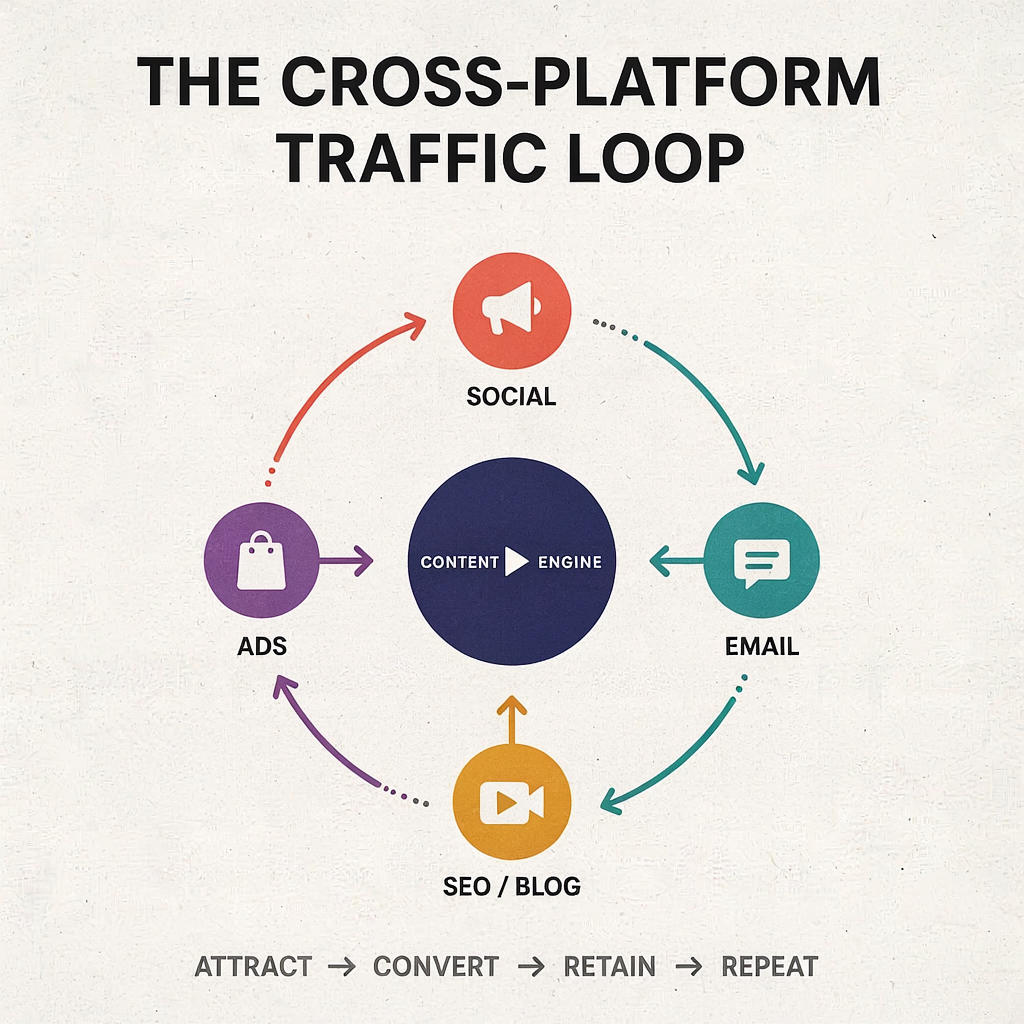
The Cross-Platform Traffic Loop
Running one platform on its own is hard, slow work. You post, you wait, you hope a few people notice, and when the platform has a bad week your traffic dries up with it.
Most sellers stay stuck right there, leaning on one channel and starting over every time it stalls.
There’s a better way to play it, and it costs you nothing but a little planning. Instead of treating each platform as a separate island, you connect two or three of them so they feed each other.
Traffic flows in a circle, and each piece makes the others stronger.
It comes together in a few clear steps. You pick a place to get found, a place you own, and a place to sell. After that, you link them so attention keeps circling back and building on itself.
One Platform Alone Leaves Money on the Table |
When you depend on a single platform, you’re renting your whole business from a company that can change the rules overnight.
A tweak to how it shows your posts can cut your reach in half, and there’s nothing you can do about it. That’s a shaky place to build.
A single platform also wastes the work you put in. You might spend an hour making something good, share it in one spot, and let it disappear by the next day.
All that effort reaches one small crowd once, then it’s gone for good.
The loop fixes both problems at the same time.
By connecting a few platforms, you spread your risk across more than one channel, and you squeeze far more reach out of every piece of content you make.
Nothing you create has to be a one-time event anymore.
| Idea: Think of your platforms like rooms in a house, not separate buildings. Each room has a door into the next one, so a visitor who walks in the front can find their way to every other room. Your job is to build the doors, not just the rooms. |
Here’s the heart of it: attention should flow in a circle, not a straight line.
A stranger finds you in one place, steps over to a place you control, takes you up on an offer, and then becomes proof that pulls in the next stranger. Round and round it goes.
Say you sell a set of printable planners. On its own, one platform brings a trickle of buyers and then dries up.
Inside a loop, that same platform sends people to your list, your list sells the planners, and happy buyers give you fresh content that pulls in more visitors.
Once you see your platforms this way, the whole game changes. You stop asking which single platform is best and start asking how to wire a few of them together.
That second question is the one that builds steady traffic instead of a constant uphill climb.
The rest of this report walks you through building that loop one piece at a time.
You’ll learn the three jobs platforms do, how to connect them, and how to keep the whole thing spinning with a couple of hours a week. None of it needs a big audience to start.
The loop also makes you far harder to knock down. If one platform has a slow month or changes its rules, the others keep the circle turning, and your owned list keeps selling no matter what.
You’re never one bad week away from losing everything you built.
Best of all, a loop rewards patience instead of punishing it. On a single platform, you’re always chasing the next post to stay alive.
In a loop, the work you did last month still pulls people in today, so your results stack up rather than resetting.
The Three Jobs Every Platform Does |
Every platform you could use falls into one of three jobs. Some are built to help strangers find you, some are places you own and control, and some are where money changes hands.
A working loop needs one platform doing each job, plus one step that ties them together.
The first job is discovery. These are the platforms where cold strangers stumble onto your stuff for free, like the visual pin boards, the short-video apps, and the question-and-answer sites.
They’re great at reach but terrible at keeping people, since the platform owns the audience, not you.
The second job is your home base. This is something you control, like an email list or your own simple store page.
Nobody can take it from you or throttle it, and it lets you reach the same people again and again, for free, whenever you want.
The third job is the sale. This is wherever the buying happens, like a checkout page, a digital storefront, or a course platform.
It’s the cash register of your loop, and its only job is to turn an interested person into a paying customer with as little friction as possible.
| Tip: Before you build anything, write down which platforms you already use and label each one discovery, home base, or sale. Many sellers find they have plenty of discovery and no home base, which is the exact hole that lets all their hard-won traffic leak away. |
The piece that ties it all together is the feedback step. After someone buys, their win becomes a story, a screenshot, or a review that you turn into new discovery content.
That fresh content pulls in the next batch of strangers, and the whole loop starts over.
Picture someone who teaches simple watercolor techniques. Discovery is a short-video app where beginners find a quick tip. The home base is an email list.
The sale is a small paid lesson pack. The feedback is a student’s finished painting, shared as the next short video that hooks more beginners.
When all four pieces are present, you have a real loop. When one is missing, the circle breaks and traffic leaks out.
A common break is having discovery and a sale but no home base, so every visitor is a stranger you have to win all over again.
It helps to remember that a platform’s job, not its name, is what counts. The same site can play different roles for different sellers, so don’t get hung up on labels.
Ask what each platform does best for you, then slot it into the job it fits.
Some platforms can even wear two hats at once. A storefront might handle both the home base and the sale, for instance. That’s fine, as long as every job is covered somewhere.
The danger is only when a job is missing, not when one platform doubles up.
Building Your First Simple Loop |
You don’t need six platforms to start. The smallest loop that works has just three pieces: one discovery platform, one home base you own, and one place to sell.
Get those three talking to each other and you have a system that already beats running any single channel alone.
Start by choosing one discovery platform you can stand to use often. Pick the one that fits how you like to create, whether that’s writing, talking on camera, or making simple images.
The best discovery platform for you is the one you’ll keep showing up on without dreading it.
Next, set up your home base, and for most beginners that means a free email list.
It’s the cheapest, most reliable thing you can own, and it works no matter what any other platform does. Your whole loop will pour traffic into this one spot.
Then pick your sale point, the page where people really buy. Keep it simple to start, even a single product on one clean page.
The goal isn’t a fancy store; it’s one clear path from interested to paid, with nothing in the way to slow people down.
| AI Prompt – Map your starter loop Act as a marketing planner. Here’s my situation: I create [type of content you enjoy making], I sell [your product or offer], and my buyer is [describe your reader]. Suggest one discovery platform, one owned home base, and one sale point that fit me. Explain in plain terms how a stranger would travel from the first to the last. |
Now connect the three with simple links. Your discovery posts point to a free offer that gets people onto your list. Your list emails point to your sale page.
That’s the whole wiring job, and it’s the part most sellers skip, which is why their platforms never feed each other.
| Hack: Make your free offer a tiny, useful version of the thing you sell. Someone who grabs a free planning checklist is already the kind of person who’ll buy your full planner pack. The free offer doubles as a filter that pulls in the right buyers. |
Say you write short cozy mysteries. Your discovery platform is a place where readers chat about books, your home base is a list, and your sale point is your store page.
A free first chapter gets readers onto the list, and the list sells them the full set.
Once those three are linked, you have a loop you can run this week. It won’t be huge yet, but it will be whole, and a whole small loop grows far faster than a big pile of disconnected accounts.
Build the circle first, then make it bigger.
Don’t wait until everything is perfect to start. A rough loop that’s running beats a flawless one that only lives in your head.
You can polish each piece later, once real people are flowing through it and showing you what needs the most work.
Give your new loop a little time before you judge it. The first few weeks are about getting the pieces connected and the habit formed, not about big numbers.
Once the wiring is solid and the routine sticks, the results have room to build on themselves.
Turning One Piece of Content Into Many |
The slow way to run platforms is to make brand-new content for each one. The smart way is to create one solid piece, then reshape it into many smaller pieces for your discovery channels.
One good idea can become a week of posts across several places.
Start with a single pillar piece, something with real substance, like a how-to article, a short video, or a detailed email. This is your source.
Everything else you post that week is just a smaller slice of it, cut and reshaped to fit each platform’s style.
From that one pillar, you can pull a handful of short text posts, a quick video script, a few one-line hooks, and an image or two.
Each one points back toward your free offer, so every slice steadily does its job of feeding people into your loop.
This is where an AI tool saves you hours. You write or record the pillar once, then let the tool do the cutting and reshaping into platform-sized pieces.
You stay the editor, keeping what sounds like you and tossing what doesn’t, but the grunt work disappears.
| AI Prompt – Repurpose one pillar into a week of posts You’re my content repurposing assistant. Take this pillar piece: [paste your article, script, or email]. Turn it into five short social posts, one short-video script under sixty seconds, and three one-line hooks. Keep the tone [describe your tone], and end each piece with a soft nudge toward [your free offer]. |
Reshaping matters because each platform has its own feel. A post that lands on a fast text feed reads differently from a slow visual board or a video app.
Same idea, different clothes, so it fits in wherever it shows up instead of looking out of place.
| Warning: Don’t just paste the exact same words everywhere and call it done. People can tell, and the platforms can tell too. Spend the extra few minutes to match each platform’s style, because content that fits in gets seen, while copy-paste content gets buried. |
Picture someone who sells a meal-planning bundle. The pillar is one article on planning a week of dinners.
From it come short tips, a quick cooking video, a grocery-list image, and a few punchy lines, each sending people to a free sample week on the list.
Working this way means your output goes up while your effort goes down. You stop staring at a blank screen for every platform and start running a small content machine off one good idea a week. That’s the rhythm that keeps a loop fed without burning you out.
Let the AI handle the boring reshaping, but keep your own voice on top of everything. Read each piece it gives you and fix anything that sounds stiff or generic. The tool speeds up the work, yet your personality is what makes people stop and trust you.
Save your best pillar pieces, because the strong ones can be reused down the road. A great article or video can be refreshed and sent out again months later to new followers who never saw it. One pillar can feed your loop more than once.
Writing Hooks That Stop the Scroll on Discovery |
Discovery content lives or dies on its first line. People scroll fast and decide in about a second whether to stop, so your opening has to earn the next moment of attention.
Get the hook right and the rest of your post gets a chance to land.
A hook is a small promise that the next line is worth reading. It can tease a result, name a problem, or ask a question your buyer can’t help answering.
Whatever shape it takes, its only job is to stop the scroll and pull the reader in.
Lead with the payoff, not a slow windup. Open on the result someone wants or the pain they feel, and save the setup for later.
A post that starts with the good part keeps people reading, while one that warms up slowly loses them before it gets going.
| AI Prompt – Generate ten scroll-stopping hooks Act as a copywriter. My topic is [your topic] and my buyer is [describe your reader]. Write ten short opening lines that would stop this person from scrolling. Mix promises, problems, and questions, keep each under fifteen words, and make them sound like a real person. |
Curiosity works, but only if you pay it off. A line that hints at something interesting earns the click, yet if the rest of the post never delivers, people feel tricked and tune you out.
Open a small loop in their mind, then close it with real value.
| Tip: Write five hooks for every post and keep only the strongest one. The first line you think of is rarely your best, so spending two extra minutes on options often doubles how many people stop to read. The hook deserves more care than the rest of the post. |
Aim your hook straight at your buyer’s problem. The more it sounds like the exact thing keeping them stuck, the harder it becomes to scroll past.
Generic openings get ignored, but a line that names a real frustration makes the right person feel seen and read on.
Say you sell a meal-planning bundle. A weak opener says planning is important, which nobody stops for.
A strong one names the pain head-on, like the nightly scramble to figure out dinner, which stops every tired person who knows that feeling all too well.
Keep what works and do more of it. When a hook earns a lot of attention, write three more in the same style and reuse that pattern.
Over time you build a small stash of openings that reliably stop your buyer, which makes every discovery post easier to start.
Strong hooks are what keep the top of your loop full.
No matter how good the rest of your system is, it needs a steady flow of strangers stopping to look, and the hook is what makes them stop.
Treat it as the most important line you write all week.
The Bridge That Captures Strangers Before They Vanish |
Discovery platforms are wonderful at sending you strangers and terrible at keeping them.
A person watches your video, nods, and scrolls on, gone forever unless you give them a reason to step closer.
That bridge from stranger to contact is the most important part of the whole loop.
The bridge is a free offer worth handing over an email for. It can be a checklist, a short guide, a template, a sample, or a quick mini-course.
Whatever it is, it should solve one small problem fast, so people feel they got a real win for signing up.
Every discovery post should point to that free offer, not straight to a sale. Asking a cold stranger to buy is too big a step, but asking them to grab something free and useful is easy.
Once they’re on your list, you can build trust and sell over time.
This step is what turns rented attention into something you own. A follower lives on a platform that can vanish or change, but an email address is yours to keep.
Every name you capture is one more person you can reach for free, again and again, for as long as you want.
| AI Prompt – Invent a free offer and write the opt-in Act as a copywriter. My buyer is [describe your reader] and my paid offer is [your product]. Suggest three free offer ideas that each solve one small problem in under ten minutes. For your best idea, write a short opt-in pitch with a headline and three lines that make signing up feel like an easy yes. |
Keep the sign-up itself painless. Ask for just an email, promise one clear thing, and deliver it right away.
The faster someone gets the free win they were promised, the more they trust you, and trust is the thing that makes the later sale feel natural instead of pushy.
| Tip: Put your free offer link in every place a stranger might land, not just your posts. Your profile bio, your video captions, and the end of your articles should all point to the same free offer. No matter where someone finds you, the bridge is right there. |
Say you teach beginner guitar. Your discovery videos show a quick riff, and each one points to a free one-page chord chart.
People grab the chart, land on your list, and now you can send them lessons and, in time, your paid course. The chart is the bridge.
Without this bridge, your loop has a giant hole in it. You can pour all the discovery traffic you want into the top, but it runs straight out the bottom.
Build the bridge first, and suddenly every bit of reach you earn starts sticking around and paying off.
Watch how many people grab your free offer, since that number tells you if the bridge is working.
If lots of strangers see your content but few sign up, the offer or the link needs work. A healthy bridge turns a good chunk of viewers into subscribers.
Treat your list like the asset it is, and tend it with care. Welcome new people warmly, keep your promises, and send things worth opening.
A list you respect will reward you for years, long after any single platform has come and gone for good.
Closing the Loop With Sales and Proof |
Once people are on your home base, the selling gets far easier, because you control the conversation.
You can warm them up, share useful tips, and make offers on your own schedule instead of hoping an algorithm shows your post. This is where the loop starts paying you back.
Sell from your home base by mixing value with offers. Send helpful emails most of the time, then point people to your sale page when you have something that fits their problem.
The trust you built with the free offer is what makes them comfortable buying from you.
Keep the sale page itself simple and clear. State what the thing is, who it’s for, and why it helps, then make buying easy.
A confused visitor never buys, so cut every extra step and question until the path from interested to paid is short and obvious.
Now comes the step almost everyone forgets: turning buyers into proof. A happy customer’s result, review, or before-and-after is the most powerful discovery content you have.
Real wins from real people pull in strangers far better than anything you could say about yourself.
| AI Prompt – Turn a customer win into discovery content You’re my content assistant. Here’s a customer result or piece of feedback: [paste the win, review, or before-and-after]. Turn it into three short discovery posts and one short-video idea that show the result without sounding braggy. End each with a soft pointer to [your free offer] so new people can step into the same path. |
This proof step is what makes the loop a circle instead of a line. The sale doesn’t end the journey; it starts the next one.
Each buyer’s win becomes fuel for discovery content that brings in the next round of strangers, who then travel the same path you built.
| Idea: Ask for a quick win or testimonial right after someone gets a result, while they’re still excited. A simple email asking what they liked best gives you a steady supply of proof, which is the raw material your discovery content runs on week after week. |
Picture someone selling a budgeting template. A buyer shares how it helped them sort their bills, and that short story becomes a discovery post.
New people see a real result, grab the free sample, join the list, and buy the full template. The circle closes and turns again.
When you treat every sale as the start of more content, your loop gets stronger the longer it runs.
Early on you supply most of the proof yourself, but over time your buyers carry more of the load. That’s the point where the loop starts to feel almost effortless.
Make the proof easy for buyers to give you. A short note asking what they liked, or a simple form, removes the friction that stops people from replying.
The smoother you make it, the more wins you collect, and the more discovery content you get free.
Spread your proof across the whole loop, not just one spot. Put a buyer’s win in a discovery post, in an email, and on your sale page.
The same story works in all three places, building trust at every stage a new person passes through.
Warming New Subscribers Into Buyers |
A brand-new subscriber isn’t ready to buy yet, and pushing too soon scares them off. They signed up for a free offer, not a sales pitch, so the job now is to warm them up.
A short welcome sequence does that work for you, on autopilot.
Your first email should deliver the free offer right away and set the tone. Hand over what you promised, introduce yourself in a line or two, and say what to expect next.
A fast, friendly start builds trust before you ask for anything at all.
The next few emails give value and let people get to know you. Share a useful tip, tell a short story about why you do this, and show that you understand their problem.
Each message makes you a little more familiar and a little more trusted than before.
| AI Prompt – Write a five-email welcome sequence You’re my email copywriter. My free offer is [your free offer], my paid offer is [your product], and my buyer is [describe your reader]. Write a five-email welcome sequence that delivers the free offer, builds trust with value and a short story, then makes one soft offer at the end. Keep each email short and friendly. |
Only after you’ve given value do you make a first soft offer. Point to your paid product as the natural next step for someone who liked the free taste. Because you led with help, the offer feels like a tip from a friend, not a pushy demand to buy.
| Idea: Set your welcome sequence up once and let it run forever. Every new subscriber gets the same warm welcome on its own, whether you’re at your desk or fast asleep. This is the part of your loop that does its best work while you focus on creating and getting found. |
Keep the emails short and easy to read. A few clear lines beat a long wall of text every time, since people skim their inbox in seconds.
Make your point, give one next step, and let them get on with their day feeling like they gained something useful.
Picture someone who teaches beginner guitar. The sequence delivers the free chord chart, shares a quick win, tells why they started teaching, and then offers the full lesson pack.
By the last email, the reader trusts them enough to buy without a second thought.
After the welcome sequence ends, keep showing up in the inbox on a steady beat. Regular, helpful emails keep your list warm so your later offers land.
A subscriber who hears from you often stays ready to buy, while one you ignore forgets you fast.
Warming subscribers is the bridge between getting attention and earning sales.
Discovery brings the strangers, the free offer captures them, and the welcome sequence turns them into people who trust you.
Skip this step and your list stays cold; build it and your loop starts to pay.
Picking the Two or Three Platforms That Fit You |
With dozens of platforms to choose from, the trap is trying to run too many at once. A loop needs only a few platforms working well, not a dozen working poorly.
Two or three you can keep up with beat ten that you neglect and abandon.
Start with the discovery platform, since that’s where your time goes. Match it to your natural strength.
Pick a writing-based platform if words come easy, a video app if you like talking on camera, or a visual board if you think in images. Play to what you enjoy.
Your home base choice is simpler, because for most sellers it’s an email list, full stop. It’s cheap, reliable, and owned, and it works alongside any discovery platform you pick.
There’s rarely a good reason to make this part complicated when you’re starting out.
For the sale point, choose whatever matches what you sell. A simple storefront suits digital downloads, a course platform suits lessons, and a checkout page suits a single product.
The rule is the same as everywhere else: pick one, keep it clean, and don’t overbuild it.
| AI Prompt – Choose your two or three platforms Act as a strategist. I’m best at [writing, video, or images], I sell [your offer], my buyer is [describe your reader], and I can spend about [your weekly hours] a week on this. Recommend one discovery platform, one home base, and one sale point that fit, and explain why each one suits me in plain terms. |
Think about where your buyer already spends time, too. The best discovery platform is one your reader uses and one you like making content for.
When those two overlap, you’ve found your spot, because you can show up consistently in a place full of the right people.
| Warning: Resist the urge to add a new platform every time you see someone else winning on it. Each platform you add splits your time and weakens the others. Master one full loop first, and only then think about adding more, once the first one runs on its own. |
Say you love writing but freeze on camera. Your loop might pair a text-based discovery platform with an email list and a simple store page.
You skip the video apps entirely, even popular ones, because a platform you dread is a platform you’ll quit within a month.
The right loop is the one you’ll really keep running, not the one that looks best on paper.
Pick platforms that fit your strengths, your buyer, and your schedule, and you’ll show up week after week. That consistency, more than any clever trick, is what makes a loop work.
If you’re brand new, it’s fine to start with a loop of just two platforms plus your list. One discovery channel feeding an email list that sells one product is a complete loop.
You can always add the third or fourth piece once the first two click.
Give any platform a fair trial before you drop it. A few slow weeks don’t mean it’s wrong for you; they often just mean you’re still learning it.
Stick with your chosen few long enough to get good, rather than hopping the moment things feel slow.
Keep your sale point honest with what you can deliver, too. Pick a product you’re proud of and a checkout that’s simple to run, so buyers leave happy.
A smooth, fair sale is what earns the proof and repeat buyers that keep your loop healthy.
Remember that you can change your platforms later if one stops fitting. Nothing here is permanent, so choose your starting few with confidence rather than fear.
The first loop is a learning loop, and what you discover makes your next choices much sharper.
Setting a Weekly Rhythm the Loop Can Run On |
A loop only works if you can keep it spinning, and that means building a rhythm you can sustain. The goal is a simple weekly routine, not a frantic scramble.
Once you have a repeatable plan, running three platforms takes far less time than most sellers expect.
Batch your work instead of doing it piecemeal. Set aside one block of time to make your pillar piece, another to cut it into platform slices, and another to schedule everything.
Doing similar tasks together is faster than bouncing between them all week long.
Plan one pillar piece a week as your anchor. From that single piece comes your whole week of discovery posts, plus material for an email or two to your list.
One good idea, fully squeezed, is plenty to keep all three parts of your loop fed.
Space your emails on a steady beat so your list stays warm. A couple of helpful messages a week keeps you familiar without wearing people out.
The aim is to be a welcome regular in their inbox, not a stranger who only shows up when you want money.
| AI Prompt – Build a one-week loop calendar You’re my planning assistant. I post on [your discovery platform], I email a list, and I sell [your offer]. Build me a simple seven-day calendar starting from one pillar piece. Show what to create on day one and what to post or send each day after, keeping the whole week under [your weekly hours] of work. |
Use scheduling tools so the work happens once and runs all week. Set your posts and emails ahead of time in one sitting, and the loop keeps spinning while you do other things.
You’re trading a bit of upfront planning for days of hands-off traffic.
| Tip: Pick the same day each week to make your pillar piece and treat it like an appointment you can’t miss. When the anchor task has a fixed home on your calendar, the rest of the loop falls into place around it, and you stop scrambling for ideas. |
Picture someone running a loop around a printables shop. Monday they make one pillar article, Tuesday they cut it into posts and schedule them, and Wednesday they write two emails.
By Thursday the week runs itself, and they’re free to start planning the next pillar.
The magic of a rhythm is that it removes the guesswork. You stop wondering what to post and start following a plan that works.
A loop on a steady weekly beat keeps drawing traffic even on the days you don’t touch it, which is the whole point.
Protect your pillar day above all else, because everything flows from it.
If the week gets busy, cut other tasks before that one, since a missed pillar means an empty week across every platform. Guard that single block of time and the loop keeps its food supply.
Build in a little buffer by working a week ahead when you can. Getting one week in front means a sick day or a busy stretch won’t break your streak.
A small cushion turns your loop from fragile to steady, even when life gets in the way.
Finding the Leak and Fixing the Weakest Link |
When a loop isn’t bringing the traffic or sales you want, the problem is almost always one weak link, not the whole system.
The skill is finding which step is leaking, then fixing that one thing instead of tearing everything down and starting over.
Walk the loop in order and ask where people fall away. Are strangers finding your discovery content at all? Are they clicking through to your free offer?
Are they joining your list, opening your emails, and reaching your sale page? Each stage has a number you can watch.
If discovery is weak, few people see your posts, so the issue is reach or content. Try sharper hooks, more posts, or a different style until strangers start noticing.
No loop can work if the top of it stays empty, so this is the first place to look.
If discovery is fine but few people grab your free offer, the bridge is the problem. Maybe the offer isn’t tempting, or the link is buried, or the pitch is weak.
A stronger free offer or a clearer call to grab it usually fixes a leak right here.
| AI Prompt – Diagnose where your loop is leaking Act as a marketing analyst. Here’s my loop: discovery on [platform], a free offer of [your offer], an email list, and a sale page for [your product]. Here’s what I’m seeing: [describe your numbers or where people drop off]. Tell me the single most likely weak link and three plain steps to fix it first. |
If people join your list but never buy, the leak is in your selling. Maybe you’re not emailing enough, not building enough trust, or not making a clear offer.
Send more helpful messages, then make a plain, specific offer, and watch whether the sales follow.
| Hack: Fix only one link at a time and give it a couple of weeks before judging. If you change everything at once, you’ll never know what worked. Change one thing, watch the numbers, keep what helps, and your loop steadily gets stronger instead of more confusing. |
Say someone has plenty of video views but almost no sign-ups. The leak is clearly the bridge, so they rework the free offer and make the link easier to find.
Views stay the same, but now people step onto the list, and the rest of the loop comes alive.
Reading your loop this way takes the panic out of slow weeks. Instead of feeling like nothing works, you can find the one stage that’s stuck and fix it.
A loop you can diagnose is a loop you can keep improving for as long as you run it.
Keep a simple record of your numbers week to week, even just a note. You don’t need fancy tools, only enough to spot whether a stage is climbing or sliding.
Trends over a few weeks tell you far more than any single day ever could.
Celebrate small fixes, because they add up fast. Patching one leak might lift your whole loop more than you’d expect, since every later stage gets the benefit.
Steady, small improvements are how an okay loop slowly turns into one that hums along on its own.
Don’t forget that the same fix often helps more than one stage. A stronger free offer lifts your sign-ups and hands you warmer buyers later.
Because the loop is connected, improving one link tends to ripple forward and lift the stages that follow it.
Keep your testing simple so you stick with it. Change one thing, jot down what happens, and decide based on a few weeks of numbers, not a single day.
Slow, steady tinkering beats big overhauls, and it keeps your loop running while you improve it.
Common Mistakes That Drain Your Loop |
Even a well-built loop can spring leaks, and most of them come from the same handful of mistakes. Knowing them ahead of time saves you months of slow results.
Here are the ones that trip up the most sellers, and how to steer clear of each.
The biggest mistake is having no home base at all. Plenty of sellers pour effort into discovery, build a following, and never capture a single email.
When the platform changes its rules, their whole audience vanishes overnight, and they start over from zero. Always own a list.
Another common slip is selling to cold strangers too soon. Asking someone who just met you to buy is a big leap, and most won’t take it.
Lead with a free offer instead, warm people up, and let the sale come once trust is there. Patience here pays off.
Running too many platforms is a sneakier trap. It feels productive, but spreading yourself across six channels means doing all of them poorly.
Two or three done well will always beat a pile of neglected accounts. Pick a few, master them, and leave the rest for later.
| Warning: The slowest killer of a loop is simply quitting too early. Loops take a few weeks to warm up, and people often give up right before results would have shown. Show up steadily for a couple of months before you decide whether your loop is working. |
Posting the same exact words on every platform is another leak. Each place has its own feel, and copy-paste content sticks out and gets buried.
Reshape your message to fit each channel, even if it takes a few extra minutes, so it blends in and gets seen.
Forgetting to collect proof is a missed chance that weakens your discovery over time. Buyer wins are your best content, so if you never ask for them, you’re throwing away free fuel.
Make asking for results a regular habit, not an afterthought you get to someday.
| AI Prompt – Audit your loop for weak spots Act as a marketing coach. Here’s my loop: discovery on [platform], a free offer of [your offer], an email list with [describe your emails], and a sale page for [your product]. Point out the three most likely mistakes I’m making, and give me one simple fix for each, in plain language. |
Say someone has thousands of followers but no list and no sales. The mistake is clear: all discovery, no home base, and no bridge between them.
They add a free offer and a list, and within weeks that same audience starts turning into subscribers and buyers.
Most loop problems come from skipping a step, not from bad luck. Build all the pieces, sell with patience, keep your platforms few, and ask for proof.
Steer clear of these common traps and your loop runs cleaner, leaks less, and keeps sending you traffic month after month.
Stacking Loops to Grow Without Burning Out |
Once your first loop spins on its own, you can grow it without doubling your work.
The trick isn’t to start over somewhere new; it’s to add one more piece to the system you already have, so the same content reaches even more people.
The simplest way to grow is to add a second discovery platform that feeds the same home base.
Your pillar piece already gets cut into slices, so sending those slices to one more channel costs little extra effort while widening the mouth of your loop.
Pick the new platform the same way you picked the first: match it to your strengths and your buyer.
Add it only once the first loop runs smoothly, so you’re building on a solid base instead of spreading yourself thin across two shaky channels at once.
| Idea: Treat your home base as the hub that every new platform plugs into. No matter how many discovery channels you add over time, they should all pour into the same list. Your owned audience keeps growing while the rest of the loop stays simple. |
You can also deepen the loop instead of widening it. Add a second, larger offer for people who already bought the first, so each buyer is worth more.
The same list and the same trust now sell two things, and your loop earns more from the traffic it already has.
Grow on purpose and slowly, one addition at a time. A loop that you expand carefully stays manageable, while one you pile onto in a rush turns into the same scattered mess you started with.
Steady, deliberate growth is what keeps the whole thing running for the long haul.
Picture someone who built a loop around a craft-pattern shop.
The first loop hums along, so they add a second discovery platform feeding the same list, then a deluxe pattern bundle for past buyers.
Same core system, more reach, more income, and barely any extra weekly work.
Once you have one loop spinning, you own a skill that works for any product you ever sell. The same pattern of discovery, home base, sale, and proof fits a new offer just as well.
Build the muscle once and you can repeat it for years to come.
Most sellers will keep treating their platforms as separate chores that never add up. You don’t have to be one of them.
Wire a few platforms into a loop, keep it simple, and let each piece feed the next, and your traffic starts compounding instead of leaking away.
A single platform will always leave you renting your reach and rebuilding from scratch. A loop changes that by linking a few platforms so each one feeds the others.
Every piece of content becomes traffic that circles back instead of vanishing after a day.
Pick your discovery spot, your home base, and your sale point, then wire them together with a free offer and a steady weekly rhythm.
Watch for the weak link, fix one thing at a time, and grow slowly once the circle spins on its own. Build the loop, and your traffic starts working for you at last.